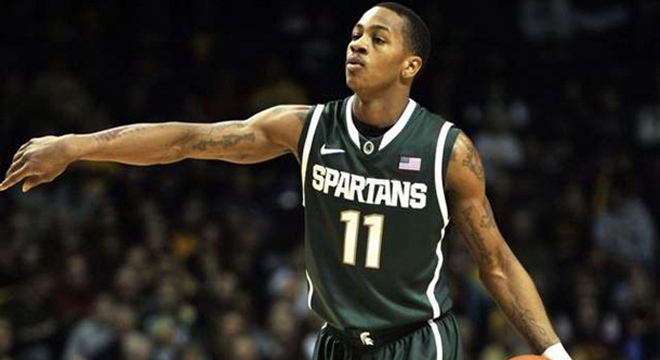
Keith Appling
PG, 6-1, 180
Senior, 22 years old
Hometown: Detroit, MI
Season (31.5 mpg): 11.2 PPG, 3 RPG, 4.5 APG, 1.2 SPG, 2.1 TO, 2.7 PF
45% FG, 36% three-point (2.7 attempts)
66% FT (4 attempts)
16 PER, 0.91 points per possession (60th percentile)
*If the videos do not appear, please “refresh” the webpage once
Coaches vs. Cancer Classic (2 Games)
November 22-23 | Barclays Center (Brooklyn, NY)
Keith Appling — PG, 6-1, 180
Senior, 22 years old
Outlook: Keith Appling is clearly MSU’s leader and tone-setter. A 21-year-old senior and former McDonald’s All-American, Appling has drastically improved his game from last season. He made a “statement” with his 22/8/8 performance vs. Kentucky at the Champions Classic, and continued his strong play this past weekend. Good pick and roll skills, surprised me with great athleticism and body control, and has an extra “burst” to get to the rim.
Perhaps most importantly, he shot the ball well: 5-9 (3-4 from 3) vs. Virginia Tech, and 8-12 (1-4 from 3) vs. Oklahoma.
Last season: 33.6 MPG — 41.5 FG%, 46.9 Effective FG%, 52.6 True Shooting%, 4.8 FTA, 1.43 AST/TO Ratio, 33.5 FG% Jump Shots
This season: 31.7 MPG — 56 FG%, 66.1 Effective FG%, 68.5 True Shooting%, 5.2 FTA, 3.40 AST/TO Ratio, 48 FG% Jump Shots
Appling has also improved his assist rate from 20.6 to 29.8, as well as his offensive efficiency rating, from 104 to 132. So yeah, quite an improvement, literally across the board. Appling is not a lottery-pick talent, but he’s young for a senior, and if he can continue to produce in the Big 10, his Draft stock will follow suit.
Pick-and-Roll Passing
Appling has always been a deft passer out of the pick and roll. This season, teammates are scoring a solid 1.12 points per possession on Appling’s P-n-R passes, ranking in the 66th percentile nationally. Great timing, passing the ball during the split-second window when the defense is frozen on the pick-and-roll. Adreian Payne’s shooting prowess certainly boosts Appling’s passing numbers, but when you think about it, he’ll play with even better shooters in the NBA. It will be interesting to see how teams try to stop Michigan State’s pick and roll, led by Appling.
Pick-and-Roll Scoring
Appling is a crafty finisher out of the pick and roll. He has a quick first step, can attack even the smallest gap in the defense, and has the body control to finish at the rim.
3-Point Shooting
As noted before, Appling’s shooting has improved across the board. Last year he shot 32% from 3-point range; this year he’s shooting 57%, on the same number of attempts. Last year he posted .94 points per possession on 3-point jump shots; this year he’s posting an excellent 1.5 PPP. We’re talking about a drastic improvement thus far.
All this being said, Appling’s slow release concerns me. NBA defenders may be able to easily close out on Appling. This will make it difficult for him to succeed at the next level. Appling needs to develop a quicker release.
Transition
In transition, Appling can lead the break or run the wings. Fast, good body control and explosiveness to finish in the paint. He can also change direction on a dime, and astutely dips his shoulder to absorb contact. Appling has made a few “wow” plays so far this season, and it’s no fluke—he’s dangerous in the open court.
Difficulty Guarding Pick-and-Roll
Appling seems to have difficulty getting around screens, allowing speedy guards to blow by him. His diminutive size makes it hard to contest jump shots, and he also needs to put on weight, as bigger defenders throw him off balance with a solid screen. His pick and roll defense is concerning.
OVERALL
Michigan State is the No. 1 ranked team in the country, and Appling is the team’s leader. Playing with increased efficiency this season, including a much-improved jump shot, we’re starting to see why Appling was so highly-touted coming out of high school. The key will be continuing his physical development while improving his passing to play point guard.
Video Breakdown: Keith Appling
If the videos do not appear, please “refresh” the webpage once.
Overview: A 2010 McDonald’s All-American, Keith Appling had a solid career directing the offense at Michigan State. He was an integral part of MSU’s attack from day one, averaging 22 minutes as a freshman and in the low-to-mid 30s for the remainder of his career. The 6-1, 180-pound senior is now considered a fringe NBA prospect, where he offers intriguing attributes for a potential backup point guard role, but also carries some pivotal question marks.
From a large-scale, more general view, Appling is an experienced floor general who can direct a bench unit at the next level. Possessing elite quickness, Appling uses his driving ability and basketball IQ to get into the teeth of the defense and create. He has break-down ability in the half court, and turns on the jets in the open floor. Appling’s driving ability allows him to use his court vision and set up teammates all over the floor.
He’s a good penetrator and distributor, but Appling is certainly not without flaws. Firstly, he needs to drastically improve his jump shot; secondly, he must improve his rhythm/aggressiveness as a point guard.
In terms of the former (shooting), Appling shot a poor 32% on all jump shots this season, and his .89 points per attempt was an average mark at best. He made 36% on 2.7 three-pointers per game, only 29% of his “guarded” jump shot attempts, and 24% off the dribble. He’s one-dimensional as currently constructed—and at only 6-1 with average athleticism, being interior oriented won’t suffice in the NBA.
In terms of the latter (inconsistent aggressiveness), it’s not something that Appling has to develop per se—I think he’s capable of doing so as currently constructed. It’s just that, for some reason, Appling seemingly hasn’t been able to “find himself” for a sustained period of time. His aggressiveness oscillates, and it permeates throughout his team because he’s the head of the snake. When Appling is in the groove, he displays a steady balance of driving aggressively and setting up teammates, and he looks the part of a second/third guard on an NBA roster.
But far too often, Appling seems like he’s playing at half speed. Whether he’s “soft” on his driving attempts, not moving the ball crisply, or defensively not putting up a fight against bigger guards.
If Appling is going to stick in the NBA, he’ll need a better jump shot, and also needs to play locked in for 48 minutes.
It must be noted that he suffered a wrist injury in early December, which ultimately lingered—and affected his on-court performance—for the rest of the season. His poor shooting predates the injury, but it’s possible that his wrist injury caused him discomfort and impacted his aggressiveness.
Below are some quotes from late March, nearly four months after the injury first occurred.
Keith Appling: “After I got hurt, I felt like a completely different player and it was hard for me to feel comfortable. I didn’t feel too good—I didn’t feel very good at all, but I still played … I’m feeling a lot more comfortable out there than when I first got back. It’s not out of my head, I think about it every now and then, but I try not to. I don’t think it affects my game, but I think about it when I’m out on the floor.”
Tom Izzo (head coach): “Keith hasn’t taken as many shots since he’s been back in the last 12 games. He was averaging about 11 shots a game in the first 20 and averaging 15, 16 points. We all know it’s because of the wrist a lot and he’s getting better, but he’s not taking even half that many shots. Last weekend he did a lot of other things for us and I think that’s critical.
The wrist has been 95 percent good for a couple weeks, but the problem is you’ve gotta get your confidence back as a shooter, as a quarterback, as a pitcher, all those different guys. The mental part becomes almost as big as the physical part, and yet he has so much more to give because he can push the ball and get it up and down. He’s one of the best defenders. I think it hurt his defense a little bit not because his body wasn’t ready but maybe because his mind wasn’t quite there. I would like to see him be a little bit more aggressive offensively because I think it will make him more aggressive defensively and on the break.”
Again: Appling uses his quickness to push the tempo, and penetrate the defense to create for himself and his teammates. He finished 61% of his attempts at the basket this season, 53% of his pick-and-roll drives, and has the court vision (2.1 A/TO) to make plays for others and, ultimately, run a unit. Defensively, Appling may struggle at times against bigger guards, but he puts pressure on the ball and has good lateral quickness to keep his man in front of him. When Appling is clicking, he has the potential to be a second or third guard on an NBA roster.
But he’ll need to develop some semblance of a respectable jump shot, and show he can run an offense for a sustained period of time. It won’t be easy.
–
Offense
Strengths
• Speedy guard who excels at penetrating the defense. Terrific driver. Can break his man down off the dribble when he is focused/aggressive (not always the case).
Speed in Transition
30% of Appling’s offense this season came in transition, where he converted a solid 59%. He is very fast, with the ability to zip through defenders and change direction in the open floor.
Finishing Ability
As mentioned, Appling finished 61% around the basket this season. He uses a quick first step to get by his defender, and can sliver through the defense for a jaunt towards the basket. He has a great first step/quickness to penetrate, but Appling should probably develop his mid-range game to compensate for size limitations at the next level. He was a putrid 8-37 (22%) on “runners” this season.
Spot Up Driving
For Appling, it’s all about finding a way to penetrate the lane. He often would spend 15-20 seconds every possession looking for an opening/opportune time to penetrate. He struggles to finish over size at the rim, but his sheer quickness made him a lethal driver in college.
Pick and Roll Driving
Due to his ability to turn the corner, Appling is effective driving on the pick and roll. He converted a solid 53% of his P-n-R driving attempts, and his 1.23 points per attempt ranked in the top 20 percentile nationally.
However, in order to maximize his pick-and-roll potential, Appling will need to develop some semblance of a jump shot. He was 5-20 shooting off screens this season, and overall was a poor shooter. Defenders will play back and dare him to shoot at the next level.
–
• Good point guard skills. Sets up teammates via penetration. 4.5 APG; 2.1 A/TO.
Drive and Dish
Drive and Kick
• Potential: A savvy point guard who can direct a bench unit, using his driving ability to create for himself and his teammates. Will need to improve his jump shot.
–
Weaknesses / Areas of Improvement
• Shaky Jump Shot (32% on all jump shots, .89 PPP)
— 36% on 2.7 three-pointers per game
— 29% on “guarded” attempts
— 24% shooting off the dribble
— Is his wrist fully healed?
• Poor jump shot really limits him. Makes him one-dimensional as a driver, which won’t suffice at 6-1.
Pick and Roll Shooting
As mentioned, Appling was 5-20 shooting off the pick-and-roll this season. He has elite quickness to penetrate, but it’s hard to use it if defenders will continuously back up and dare him to shoot.
Off the Dribble Struggles
Appling shot a putrid 9-37 (24%) off the dribble this season.
Made 3-pointers
Capable but definitely not reliable.
–
• Good driver, but he lacks a mid-range jumper/runner to compensate for size limitations. He doesn’t draw a lot of contact in the lane (5 FTA per 40), and isn’t a great athlete, so he needs a mid-range game to make defenders play up in the lane.
Can’t Finish
Gets Blocked
No Mid-Range or Runner
Appling needs a clear path to the basket, or else he will struggle to get a good look. Again—he’s short and isn’t a great leaper, so he needs an in-between game.
Right now, he doesn’t have one. 8-37 on runners, only 10 mid-range attempts this season. No floater/runner/scoop shot in the lane; he won’t survive in the NBA if he can’t develop an in-between game.
Too small in the lane, so he forces passes
Lack of height really hinders him here. Too small and no runner, so he forces passes. He’s a steady ball-handler, but turns it over because he has no escape route once in the lane.
—–
Defense
Defensively, Appling has good strength to pressure the ball and keep his man in front of him. He can cut off penetration in isolation situations, and for the most part play within a team structure.
However, he struggles to defend bigger guards, who can shoot over him or outmuscle him to the basket. He simply isn’t tall enough to contest shots.
• Quick hands (1.2 SPG)
On-Ball Steals
Help D
• But… Small Frame
Bigger Players drive on him
Bigger Players shoot over him
Too small defending the pick-and-roll