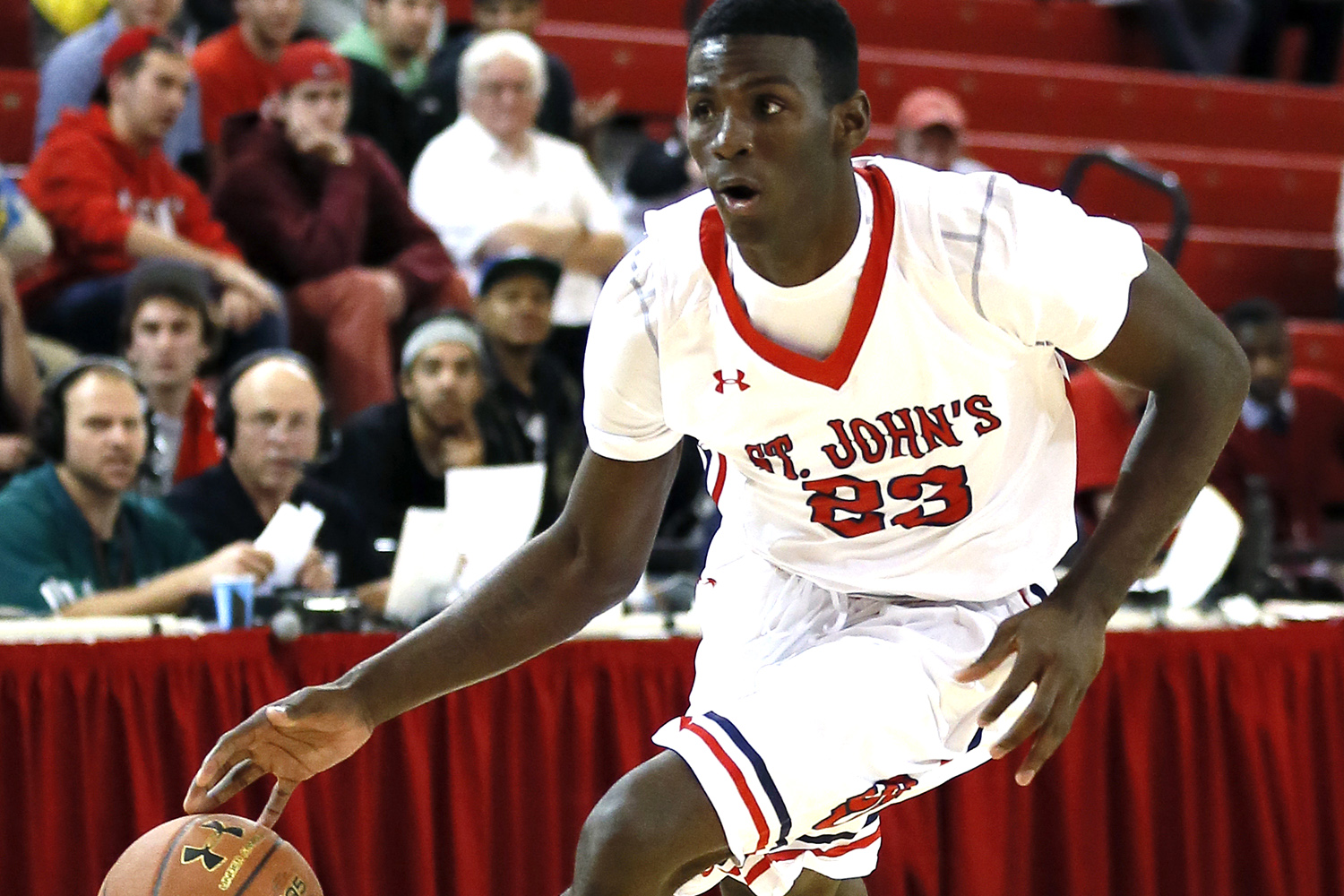
Rysheed Jordan
PG, 6-4, 185
Junior
Sophomore Season (30.7 mpg): 14 PPG, 3.7 RPG, 3 APG, 1.7 SPG, 3 TO
43% FG, 36% three-point (3.8 attempts)
66% FT (5.4 attempts)
18.8 PER, 0.86 Points Per Possession (54th percentile)
Video Breakdown: Rysheed Jordan
If the below videos do not appear, please “refresh” the webpage.
—
Strengths
• Size and Length. Jordan is a 6-4 point guard, with a 6-8 wingspan and elite athleticism. He definitely is a “big guard,” an aggressor who attacks by playing downhill, and someone who can apply pressure relentlessly on the defensive end.
Jordan is a big, athletic, team-oriented point guard with special talent. That being said, though, in order for Jordan to realize his potential and, ultimately, impact winning on a consistent basis, he must fine-tune his game in several areas. Jordan has the requisite tools; it’s largely on him to develop those tools correctly.
-
• Aggressive Scorer. Standing at 6-4 and equipped with an “attack” mentality, Jordan has the size, length and quickness to penetrate the lane and get into the teeth of the defense. He must improve his finishing ability, and decision-making (explained below), but Jordan can penetrate the defense using his size and burst.
Although he got into the paint less frequently as a sophomore—as a freshman, 50% of his shot attempts came “around the basket”, while only 34% came around the basket as a sophomore—Jordan’s driving prowess is still evident. His 7 free throw attempts per 40 minutes led St. John’s, and ranked top-50 nationally. He is an attacker first and foremost.
He can physically overpower the first line of defense, and seemingly gets o the rim at will.
Pick-and-Roll Driving/Scoring
21% of Jordan’s shot attempts this season occurred via the pick-and-roll. He is fluid to change direction with the ball in his hands, and has a “burst” to explode past his defender. He struggles finishing at the rim—he converted only 36% of his pick-and-roll attempts, and his 0.75 points per attempt ranked in the 55th percentile nationally—but man, his ability to get to the basket is special. With an improved jump shot, he can become a dual threat (shooting and driving) on the P-n-R.
Capable in Isolation Situations
Jordan can “bully” most point guards using his 6-4 size and quickness. Crafty footwork (euro-steps, spin moves, hesitation dribbles) to create separation and get a clear shot attempt. The defense must always keep a body on Jordan or he will make you pay.
Overall Finishing Ability
As mentioned, 34% of Jordan’s overall shot attempts came “around the basket” this past season. He converted a solid 55% at the rim, and his 1.1 points per attempt ranked in the top 57th percentile nationally. Not great, but certainly capable. With some added weight and more discipline in terms of driving with a purpose, Jordan can become a lethal finisher. Examples in the video below.
-
• Improving Jump Shot
Freshman (2013-14):
46% of shot attempts are jump shots
29% FG on jump shots, 28% three-point (2.1 attempts), 66% FT
36% FG on short-range jumpers
25% FG on mid-range jumpers
Sophomore (2014-15):
65% of shot attempts are jump shots
37% FG on jump shots, 36% three-point (3.8 attempts), 66% FT
44% FG on short-range jumpers
27% on mid-range jumpers
It would be irresponsible to examine Jordan’s shooting ability in a vacuum—that is, without considering his improvement from year 1 to year 2. His jump shot is still a (major) work in progress (37% FG on all jumpers; 66% FTs; he tends to fade away for no reason; he’s not consistent in his release; etc), but Jordan has shown progress.
This season—unlike last—Jordan has shown the ability to knock down shots consistently and with confidence. Often in an “off guard” role, Jordan stayed ready, in a “shooting position”, particularly from 3-point range. When he set his feet and had a straight release (no fade away), Jordan was a very good shooter. He shot 49% on unguarded catch-and-shoot opportunities, and 43% on all catch-and-shoot opportunities, both better than his 37% FG on all jumpers. Where he struggles most is shooting off the dribble—Jordan gets off balanced and struggles to compose himself off the bounce, as evidenced by his 31% FG shooting off the dribble this season.
With his already-established driving ability, Jordan’s perimeter jump shot will largely determine his impact. It could transform him from a “scoring threat” to a “takeover” type of player. An improved jump shot will open up the floor for him to operate, both in terms of driving lanes and also finding teammates. His shot selection and shooting form still need improvement, but his shooting ability leaves me optimistic.
Shooting with Confidence
3-Point Shooting (36%)
Free Throwing Shooting (66%)
FT Misses
FT Makes
-
• Defensive Ability (when focused)
Jordan has the physical tools and on-court engine to become an elite perimeter defender. Using his 6-8 wingspan, Jordan can literally envelop smaller point guards, and he is quick enough laterally to stick with PGs or SGs on the perimeter.
Jordan has quick hands and great anticipatory skills, as his 1.7 steals per game ranked 5th in the Big East, and his 3.4% steal percentage ranked top-50 nationally. He stops the ball at the point of attack, has quick feet and hands, and competes hard.
Jordan’s focus must improve defensively (explained below), but overall, he has the potential to be a lockdown defender.
On-Ball Pressure / Quick Hands
Lazy Close-Outs (must improve focus)
–
Weaknesses / Areas of Improvement
As mentioned, Rysheed Jordan has the physical attributes, competitive engine, and overall skill level to be an elite college player, and in turn, a legitimate NBA point guard prospect.
But he is still “raw,” unpolished in certain areas. If he ever wants to realize his potential, he must improve, particularly in three areas: (1) Decision-Making/Point Guard Skills; (2) Perimeter Shooting; (3) and getting stronger/adding muscle to his 185-pound frame.
Super talented, but this could go either way.
• Point Guard Skills: Decision-Making, Poor Shot Selection
Jordan has flashed brilliance, but also moments of underwhelming, turnover-prone play. He recorded a mediocre 1/1 assist-to-turnover ratio, and he finished 2nd in the Big East in total turnovers. Jordan’s large 27% usage percentage ranked 3rd in the Big East, which compensates partly for his turnovers, but still, on film it’s clear he must improve his decision-making.
He often has “tunnel vision,” ignoring open teammates and prematurely going into “takeover” mode. He cant’ do this as a team leader, as a point guard.
He really struggles to advance the ball in transition, he dribbles incessantly on the perimeter, and he forces the issue. Combined with an inconsistent jump shot, his decision-making really limits his overall effectiveness. If he was a little more patience and deliberate in his actions, Jordan would be an MVP-level player as currently constructed.
Good: Court Vision (simple passing)
Nothing special, but still worth noting: Jordan is not “selfish” at all. He can make the simple pass, and occasionally, he draws defenders and passes out to open teammates.
Poor Shot Selection (Tunnel Vision/Forcing The Issue)
-
• Inconsistent Shooting
As mentioned above, Jordan is an improved shooter, albeit still inconsistent. He converted 37% of his overall jump shot attempts. He has improved in catch-and-shoot situations—particularly from 3-point range—but he struggles shooting off the dribble. Jordan converted only 31% shooting off the dribble, and 27% from mid-range, which is another form of gathering yourself off the dribble.
He has a tendency to fade away. Just needs a little more patience.
Tendency to fade away
Mid-Range Shooting Struggles (27% FG)
3-Pointers (28% FG)
-
• Weak Frame (must get stronger to finish his drives)
This past season, Jordan got to the basket at will, but he struggled to finish once there. He converted only 54% of his attempts around the basket, and his 1.1 points per attempt ranked in the 57th percentile nationally. Not terrible, but given his quickness and athleticism, you’d like for it to be more consistent.
Too much reverse, double-pump, herky-jerky move. He must get stronger to finish through contact.
Weak Frame
Transition Finishing Struggles
26% of Jordan’s shot attempts came in transition, but he only finished 48% of his buckets in the open floor. Partly due to shot selection, but also due to a weak frame.
-
• Will Rysheed Jordan realize his potential? What’s his position/role? Can he be a full-time point guard?
Last season, Jordan was used as a “lead guard” who attacks in transition and gets to the rim in the half court. He can make plays for himself and others, but he must polish his point guard skills to maximize his size and optimize his overall impact.
Jordan is a rare—maybe even a spectacular—talent. But he must improve his decision-making and learn how to play within the constraints of an offense. He’s a loose cannon at times, and entering his junior year, he must refine his decision-making and show improved patience. If he can become more patient and composed, Jordan is talented enough to garner Big East Player of the Year consideration. St. John’s is fortunate to have him.