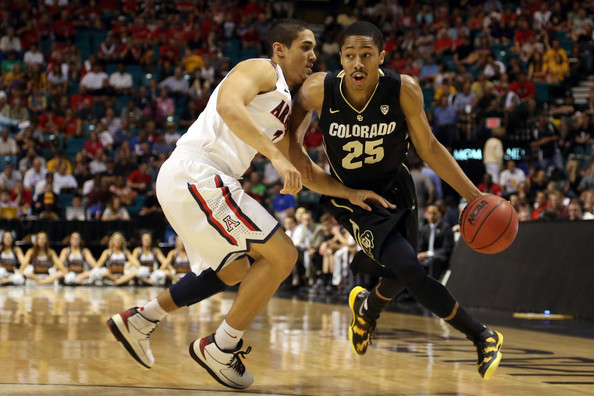
Spencer Dinwiddie
G, 6-6, 200
Junior, 21 years old
Junior (17 Games)
31 MPG, 14.7 PPG, 3 RPG, 3.8 APG, 1.5 SPG, 1.8 TO
47% FG, 41% three-point (3.7 attempts)
86% FT (7 attempts)
67% TS, 26.3% assist rate
24.8 PER, 1.17 Points Per Possession
Sophomore (33 Games)
32.5 MPG, 15.3 PPG, 3.2 RPG, 3 APG, 1.3 SPG, 2.2 TO
41% FG, 34% (4.2 attempts)
83% FT (7.3 attempts)
59% TS, 20.2% assist rate
22.8 PER, 0.998 Points Per Possession
Video Breakdown: Spencer Dinwiddie
* I have not seen Dinwiddie compete live this season. The following breakdown is based on watching film and doing research. If the videos do not appear below, please “refresh” the webpage once.
–
• Dinwiddie tore his left ACL in January — how will he recover? Dinwiddie was 17 games through his first year as full-time point guard when he suffered the injury. Both statistically and on film, he looked capable of running the show. Great size for a point guard at 6-6, and his assist percentage increased from 20.2% to 26.3%. He was starting to find himself as a floor general, not only as a scorer (14.7 PPG on 47% shooting), but also facilitating for his teammates.
But how will Dinwiddie return? Is he back to normal? Even prior to the injury, Dinwiddie lacked NBA quickness and athleticism; he played below the rim but used his 6-6 size and 6-8 wingspan to compensate. Now, following his injury, can he afford to lose another step? Defensively, can he stay in front of quick NBA point guards? Offensively, can he still turn the corner on the pick-and-roll with the same pre-injury burst? There are question marks stemming from his ACL injury, none of which I’m qualified to speak or speculate on. But there are questions.
–
• Size for position. Dinwiddie is a 6-6 point guard who can play off-ball as well. He’s an oversized ball handler, who can play both backcourt positions but excels primarily with the ball in his hands. The reason he’s most effective with the ball in his hands is because (i) he has legitimate court vision to create for his teammates, but more so, because (ii) he can use his 6-6 frame to tower over traditional point guards and maneuver his way around the court.
Scoring-wise, Dinwiddie prefers to break his man down off the dribble, where he can use his size, ball handling, and long strides to penetrate the lane. However, he’s more “smooth” than “athletic,” something that could be problematic down the road.
He’s a proven shooter (40% and 1.13 PPP on jump shots, ranking in the top 12th percentile nationally), capable of knocking down shots with his feet set (43%) or off the bounce (35%). He’s not a “pure” shooter by any means, but Dinwiddie’s dual scoring threat makes him effective as a 6-6 PG. He can drive via the pick-and-roll, or shoot from outside, on or off the ball. His numbers were consistent as a sophomore as well.
If you back off, he’ll knock down the jumper; if you play up on him, he’ll use his size to penetrate and create for others. Prior to his injury, Dinwiddie astutely used his 6-6 size to his advantage—he averaged 7 free throws per game, and his 6.2 fouls drawn per 40 minutes ranked 50th nationally.
Size and shooting allow Dinwiddie to slide off the ball and play alongside a smaller point guard as well. But he probably lacks the quickness to guard and create against NBA wings, so he’s optimal with the ball in his hands. He’ll lose his competitive advantage if he strictly plays off the ball.
Creating For Himself (scoring)
He’s versatile and can score in a variety of ways. Really uses his size well. Tough to find point guards his size.
— Driving (using size and length)
Dinwiddie can shield defenders, lower his shoulder, and rise over the defense. He does a good job drawing contact en route to the basket.
— Drawing Fouls (7 FTs per game, 6.2 fouls drawn per 40 minutes; 50th nationally)
— 84% Free Throw Shooter
— Transition
Dinwiddie was excellent in transition throughout college. He converted a solid 53% and produced 1.2 points per transition attempt this past season. He’s smooth, rangy, and can “glide” in the open floor.
— Can shoot off the dribble (numbers identical this year and last year)
34% shooting off the dribble. Capable off the bounce, but not a pure shooter or a wizardry ball handler.
— Catch-and-Shoot 3-Pointers (43%, 1.28 PPP)
Creating For Others (passing)
Dinwiddie really improved as a passer this past season. He showed great pace and court vision, really showcasing some critical point guard skills. Most of all, he’s not reluctant to swing the ball. He trusts in the plays and lets the offense take care of itself.
He scans the floor with pace, court vision, and timing. Excellent stuff, in my opinion.
— Drive-and-Kick / Simple Passes
— Drive-and-Dish / Alley-Oops & Cutters
— Passing Ahead (transition)
–
• Although he has great size for the position, Dinwiddie is not very quick or explosive, which limits his ability to (i) finish at the basket, and (ii) break his man down off the dribble. Will he be able to score at the NBA level?
He lacks explosiveness, instead, taking more of a finesse, I’ll take it slow and glide through the lane approach. Dinwiddie struggles to power or speed through defensive resistance in the half court.
He compensates—partly—via the pick-and-roll, where he can rise over the defense for a jumper or attack the open lane. Dinwiddie converted an excellent 42% and produced 1.06 points per pick-and-roll attempt this season, one of the top marks nationally (95th percentile). His pick-and-roll production was nearly identical as a sophomore as well.
However, if he doesn’t have a screen, Dinwiddie struggles to power or speed his way through. Will this be an issue at the NBA level? To his credit, Dinwiddie demands that defenders respect his jumper, which makes it easier to drive. And he’s adept at drawing fouls.
But in terms of breaking his man down, there are some concerns. He finished only 50% of his around-the-basket attempts in the half court as a sophomore, often getting rejected at the rim. He’s also not a pure outside shooter, which heightens the uncertainty because he can’t just rely on his jumper. While he’s pretty efficient overall, there are times when he hits cold spells, and misses badly on jumpers/layups alike.
To his credit, and overall, Dinwiddie found a way to make it work, leading Colorado to a early top-20 ranking and 14-3 record, including wins vs. Kansas/Oregon/Harvard. Assuming he’ll return to pre-injury form, the totality of Dinwiddie’s game—passing, shooting, versatility, ball handling—probably negates his athletic shortcomings. But it’s still worth noting, and causes (some) concern.
“Good”
Pick-and-Roll
— P-n-R Driving (finished 52% of P-n-R drives last season, 83% this season [6 attempts])
— P-n-R Shooting / Pulling-Up (finished a solid 39% of his pick-and-roll jumpers, and his 1.05 points per attempt ranked in the top 20th percentile nationally)
“Concerning”
Finishing Struggles / Inconsistent Shooting
— Not Very Explosive
— Catch-and-Shoot Misses (43% this season, 39% last season; not bad but still a little room for improvement)
— Off the Dribble Misses
Again: 34% shooting off the dribble. Capable off the bounce, but not a pure shooter or a wizardry ball handler.
–
• Serviceable defender, but nothing special one way or the other. Dinwiddie has the size and length to guard both backcourt positions. However, he lacks elite quickness to stay in front of his man. Dinwiddie used his length and height to disrupt passes (1.5 SPG), but he has a small margin for error due to average quickness/agility. Give and take here.
He looks like a serviceable defender on film, but nothing moves the needle one way or the other. He towers over opposing point guards, but, gets beat by quicker guards. Assuming he recovers to pre-injury form, he should suffice defensively.
— Steals
— Overall, “Decent” Defense