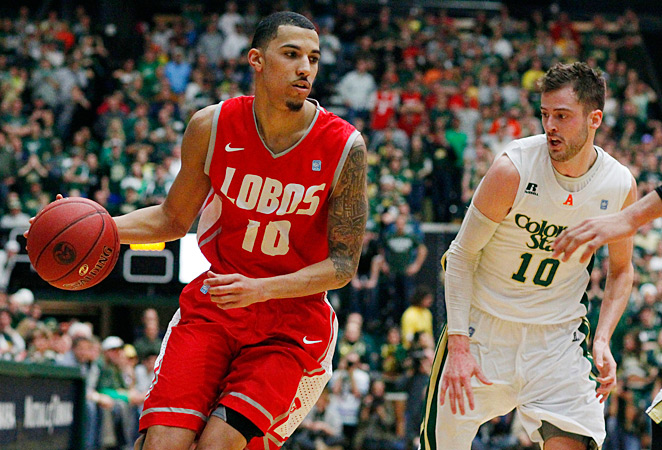
Kendall Williams
G, 6-4, 180
Senior, 22 years old
Hometown: Rancho Cucamonga, CA
Notable: 2012-13′ Mountain West Player of Year
Season (35 mpg): 16.4 PPG, 3.5 RPG, 5 APG
44% FG, 41% three-point (4.7 attempts)
28.8% assist rate (103rd nationally)
22.3 PER, 1.05 points per possession (89th percentile)
New Mexico head coach Craig Neal: 505-917-3561
Lamont Smith (associate HC): 480-784-7236
Craig Snow (assistant): 505-715-0771
Practice Report: New Mexico Lobos
Tuesday, February 4 | The Pit (Albuquerque, NM)
Kendall Williams — G, 6-4, 180
Senior, 22 years old
Season (35 mpg): 17.6 PPG, 3.6 RPG, 5.3 RPG, 2 SPG
Notes: The reigning Mountain West player of the year, Williams is a wiry combo guard with excellent speed and a good first step. Due to his speed, it’s difficult to keep him out of the lane. He can score in a variety of ways in the lane, using either hand to finish at the rim. He’s also showcased a developing mid- and long-range jumper, though not with consistency.
Williams can play on or off the ball. In transition, he can push the ball or run the wings; in the half court, he can run the pick-and-roll, or use off-ball screens to free himself. He’s a dynamic weapon on the college level, as he can go for 46 points one game, then 17-and-10 the next.
But, at 6-4 and 180 pounds, Williams is a tweener. He lacks the lateral foot speed and the strength to defend NBA shooting guards. Too slow and too small to defend NBA shooting guards.
If he’s going to make it, it’ll be as a point guard. But—and to my disliking—Williams played off the ball in practice. His jump shot, which has been hit or miss throughout his career, was out of sync on this day. I enjoy his game, but quite frankly, he looked out of place on the college level, let alone within the context of the NBA.
One aspect he did excel in was his communication and leadership. Williams constantly communicated on the court, calling out screens and defensive assignments. Terrific leadership here.
Overall, Williams was solid—made a few jumpers, finished at the rim, changed direction in the lane—but nothing special. Maybe that’ll change in the game tomorrow.
*If the videos do not appear, please “refresh” the webpage once
New Mexico 66, Wyoming 61 (OT)
February 5, 2014 | The Pit (Albuquerque, NM)
Kendall Williams — G, 6-4, 180
Senior, 22 years old
Season (35 mpg): 17.6 PPG, 3.6 RPG, 5.3 RPG, 2 SPG
29% assist rate; 95th nationally
Game: 13 pts, 4 rbs, 0 ast
2-13 FG, 0-6 three-point, 9-12 FT
Outlook: Williams had one of his worst performances this season. He was overly passive early on, and was imprudent/forceful in his shot selection. I’m not sure if he was told to play a certain way, but the result was a 2-for-13 performance, including his first zero-assist game of the year.
Williams is a “rhythm player”, and he couldn’t find his groove on this particular day. If you put this performance in a bubble, you’d think Williams is not an NBA prospect. But obviously, being the reigning Mountain West POY, he’s a proven commodity in college basketball.
Through observing him over the last two years, his makeup as an NBA prospect is clear. Here’s what I wrote following Tuesday’s practice, slightly modified:
“A wiry combo guard with excellent speed and a good first step. Due to his speed, it’s difficult to keep him out of the lane. He can score in a variety of ways in the lane, changing direction in the paint and using either hand to finish at the rim. Good body control and speed in the paint. He’s also showcased a mid- and long-range jumper, though not with consistency.
Williams can play on or off the ball. In transition, he can push the ball or run the wings; in the half court, he can run the pick-and-roll, or use off-ball screens to free himself. He’s a dynamic weapon on the college level, as he can go for 46 points one game, then 17-and-10 the next.
However, at 6-4 and 180 pounds, Williams is a tweener. He lacks the requisite foot speed and strength to defend NBA shooting guards. Too slow laterally, and too small physically.
If he’s going to make it, it’ll be as a point guard. But Williams played off the ball against Wyoming. His jump shot, which has been hit or miss throughout his career, was out of sync—and frankly a disservice—on this day.”
Strengths
— Excellent first step to get in the paint
— Capable finisher with both hands
— Draws contact (8.3 FTA)
— Second burst “turning the corner” on screens
— Can play on-or-off ball
— Good hands defensively (2 SPG)
— Gifted scorer when feeling it
Defects/Areas of Improvement
— Has makeup of PG, not SG (6-4, 180; needs to make full transition)
— Can he make plays for teammates at the NBA level?
— Can he finish over NBA size?
— Skinny, arguably weak
— Often turns back against pressure; not a great one-on-one player
Video
2-13 FG vs. Wyoming
Drawing contact vs. Wyoming (9-12 FT)
04/27/14
Overview: Kendall Williams finished his college career with a forgettable performance on a big stage. In an opening-rounded NCAA Tournament defeat vs. Stanford, Williams recorded 3 points (1-9 FG), 5 rebounds, 5 assists and 2 turnovers. Not what you’d expect from a former conference POY and New Mexico’s floor general.
Despite that performance, though, Williams had a solid career at New Mexico, averaging 30 minutes per game and leading the Lobos for four consecutive seasons. He is most known for his 46-point scoring barrage at Colorado State last season, but Williams has a solid body of work, with per 40 minute averages of 18 PTS/5.6 AST/4 REBS/1.8 STL this season.
Standing at 6-4, Williams is a scoring-oriented combo guard with a wiry frame. He can facilitate—averaging 5 assists per game this season, with great vision and accuracy—but Williams is more of a natural scorer than facilitator (at least right now).
Williams’ best attributes are his extreme speed and solid size for the position. At 6-foot-4, Williams is very fast with the ball, which makes it tough to stop him from getting into the lane. Williams has a quick first step to penetrate the defense off the bounce, where he can get into the teeth of the defense and make decisions—pull-up for the jumper, kick out to a shooter, or drop it off to the post man or cutter.
However, although Williams is fast with the ball in his hands, he is not very creative with the ball. At this point, Williams mostly relies on screens to give him time and space to attack. He can only utilize his speed if an open lane is present, usually created by the pick-and-roll. Williams shot 6-25 driving in isolation sets this season (no pick-and-roll); he struggles to ward off defenders and create separation on drives. Conversely, he scored an excellent 1 point per possession on the P-n-R. This was no accident, and it’s apparent on film as well.
He clearly struggled to create space and be creative off the dribble. He has terrific speed—which is best utilized in transition (1.35 PPP), and off the pick-and-roll (1.0 PPP scoring)—but he lacks advanced ball-handling skills and the necessary “explosion” to create off the dribble. Excellent speed, yes; but not very explosive.
Williams’ inability (or reluctance) to get his jumper off/penetrate without relying on a screen leaves him stranded on the perimeter, where he often settles for a jump shot. You could argue that Williams is overly reliant on his jump shot. 69% of his shot attempts this season (and 72% last season) were jumpers, where he converted a good-but-not-impressive 36%. 81% of those jump shot attempts were from behind the arc, converting 39% this season (1.9-4.8).
Don’t get me wrong: Williams has shown he’s capable of making jump shots, from mid and long range. After all, he made 10 3-pointers vs. Colorado State last season.
But at the crux of his skill set, what you have is this: A 6-4 “combo guard” who lacks the athleticism to finish in the paint, the necessary handle to even get into the paint save for a screen, and a reliable jump shot. Additionally, right now Williams lacks the decision making skills (poor shot selection) and handle to run a team as a full-time point guard.
If an NBA team drafts Williams or picks him up for summer league, it will do so with the hopes that Williams can improve his ball handling and shooting. They would hope that—even if he’ll never jump high or be explosive—Williams can run the pick-and-roll, penetrate the lane to create, and most importantly be able to make shots off the dribble. When you watch Williams right now, there are games when his jump shot is clicking and he can effectively run a team. He looks worthy of a Draft selection in those handful of games. But he’s played to his potential—being an all-around playmaker, finding the correct balance of scoring and distributing—only in small glimpses. The question is whether he can sustain this, whether he can temper his shot selection and improve as a finisher. He struggled to finish around the basket this season, making only 28 of 58 attempts, but this will have to improve. Adding muscle to his 180-pound frame is the first step.
Great court vision, good but inefficient shooter, fast but needs to improve as a finisher, and needs to improve his shot selection.
On the other end of the court, Williams could be vulnerable as a defender. Poor foot speed and a skinny 180-pound frame will give him difficulty defending NBA shooting guards. Although Williams can be a good on ball defender at times—particularly in the passing lanes, where he has terrific anticipation skills and led the mountain west conference with 1.6 SPG—he needs to improve his foot speed and lateral quickness.
Right now, Williams struggles to slide his feet guarding in isolation, gets outmuscled by bigger guards, and struggles to consistently get around screens. Williams is only allowing .64 points per pick-and-roll attempt (ranking in the top 25 percentile nationally), but on film it’s clear that he struggles to get around screens regardless if the offensive player converts the basket. His 1.13 PPP allowed on spot up possessions, and 1.07 PPP in isolation—both in the bottom 80th percentile nationally—are more indicative of his defensive ability.
Overall, Williams is fast and fearless, with good size assuming he’ll play PG. He is tough and gritty, and can make big shots. If he can improve his playmaking skills while also minimizing careless shot selection, Williams could find minutes as a 6-4 PG. He’s been a prolific shot maker on occasion, showing NBA speed and facilitating skills—aka being an effective point guard. But conversely, Williams is already 22 years old, and he still hasn’t figured out how to blend his scoring and passing. He must do so in order to establish a defined role, and have a chance of making the NBA.
Strengths
— Good size for a combo guard (6-4)
— Quick first step to get into the paint, especially on pick-and-roll, where he has excellent vision
— Very quick in the open court (1.55 PPP points and assists in transition; 88th percentile nationally)
— 39% 3-point shooter; shows potential
— Capable finisher with both hands
— Draws contact (6.7 FTA)
— Can play on-or-off ball; in constant motion off the ball
— Reads the passing lanes well (1.6 SPG)
— Can be very dangerous when jump shot is falling (46 points vs. Colorado State last year)
Weaknesses/Areas of Improvement
— Must improve point guard skills to survive in NBA; won’t make it as a 6-4, 180-pound SG
— Must improve jump shooting accuracy and shot selection
— Struggles to finish at the rim (28-58 this season, 1.0 PPP)
— Lacks explosion and athleticism to be creative off the dribble; struggles to break his man down
— Sometimes vulnerable as a man-to-man defender; needs to improve foot speed and lateral movement
— Must blend scoring and passing to establish a defined role in the NBA
Video Breakdown: Kendall Williams
*If the videos do not appear, please “refresh” the webpage once
Offense
Strengths
Operating the Pick-and-Roll
28% of Williams’ possessions this season were in the pick-and-roll, by far his most frequent offensive set. In fact, the pick-and-roll composed 33% of his half-court attempts. Williams scored 1.0 points per pick-and-roll attempt, ranking in the 91st percentile nationally. This is mainly because Williams has a quick first step to get around screens and into the lane, with a soft touch to finish in the lane. 56% of his pick-and-roll attempts were dribble-jumpers, while he only took 20% all the way to the basket.
Although Williams lacks the strength and athleticism to consistently finish at the basket, he is by far most effective creating off the pick-and-roll, where he can get into the teeth of the defense and make plays.
Pick-and-Roll Driving
Pick-and-Roll Shooting
Williams posted 1.2 points per pick-and-roll jump shot, ranking in the 91st percentile.
Passing to Pick-and-Roll Man
Like the rest of his facilitating arsenal (explained below), Williams has great timing and accuracy hitting a rolling screener.
–
Quick First Step / Speed
Very quick in the open court. Changes direction with the ball, accurate passing and finishing. Williams led the Mountain West Conference in assists, in no small part due to his transition passing. He can lead the break, or run the wings on the break and make plays for himself/others. His 1.355 points per transition attempt ranked in the 89th percentile nationally, and it’s no fluke.
Williams’ speed and court vision are very effective in the open court, where defensive resistance is at a minimum.
Open Court Speed (passing)
Open Court Speed (finishing)
Gets ahead of the defense.
Open Court Speed (finishing part 2)
Leaks out way ahead for dunks, break-away layups.
–
Court Vision / Facilitating
Williams’ 4.9 assists per game (and 168 total assists) led the MWC. He has very underrated passing instincts in my opinion. Excellent accuracy, timing, and set-up ability.
Potential to play point guard. “Cutting” teammates converted 88% of Williams’ passes; he can thread the needle.
Drive-and-Dish
Drive-and-Kick
“Threading the Needle”
Passing to Cutters
–
Capable Shooter
70% of William’s attempts are of the jump shot variety, where he converts 36%. He is certainly a capable shooter, but considering his over-dependence and poor shot selection, his jump shot can be tightened up. His shot selection and accuracy must both improve, but, he can make shots.
Made 3′s
71% of Wiliams’ jump shots are 3-pointers. He converted 39% on 4.8 attempts per game this season.
Off the Dribble Makes
Williams shoots a considerable amount of “off the dribble” jump shots. This is encouraging, as many pro prospects need to improve their handle on the perimeter. Williams keeps his dribble alive, and can pull-up. His .87 points per “off the dribble” attempt ranked in the 71st percentile this season.
*****
Weaknesses / Areas of Improvement
Average Jump Shot
— Decent, but not great shooter. Additionally, Williams has an awkward shooting form and an inconsistent landing.
Missed 3′s
Off the Dribble Misses
–
Decision Making (poor shot selection)
Poor Shot Selection, Half Court
— Williams needs to do a better job of recognizing time and score, especially as a point guard. He doesn’t seem concerned or aware that it’s his job to make smart plays.
His propensity to jack up shots early in possession is, frankly, unacceptable.
Poor Shot Selection, Transition
— Williams settles for 3-pointers in transition. Why? Does he not have confidence to finish at the rim?
— Not a great 3-point shooter to begin with … much less to jack up shots with 30 seconds on shot-clock.
–
Finishing Struggles / Average Ball-Handling
5-22 Driving left
Williams went left on 46 of 51 isolation drives. He attempted 22 field goals on those 51 possessions, and only converted 5-22.
Without a screen, he struggled to create space and finish through defensive resistance.
Missed Short-Range Jumpers
— 3-18 on short-range jumpers this season. Why doesn’t he attempt to take it all the way?
— Not explosive.
Around the Basket Misses / Poor Lift?
— Gets blocked, lack of explosiveness
— Will be he be able to finish through/over NBA length? It won’t be easy. Needs to add muscle.
5-22 “runners” (not much of a floater)
Turnovers
Williams is not “turnover prone” (2 turnovers per game), but he sometimes loses control and attempts ill-advised passes. Nothing egregious, but he should tighten his handle.
******
Defense
Strengths – Steals
— Very good at reading passing lanes. Quick hands; 1.6 steals per game led the Mountain West.
Weaknesses / Areas of Improvement
On Ball Defense
Williams could be vulnerable as a defender. Poor foot speed and a skinny 180-pound frame will give him difficulty defending NBA shooting guards. While Williams can be a good on ball defender at times—particularly in the passing lanes, where he has terrific anticipation skills and led the mountain west with 1.6 SPG—he needs to work on his foot speed and lateral movement.
Right now, he struggles to slide his feet guarding in isolation, gets outmuscled by bigger guards, and struggles to consistently get around screens. Williams is only allowing .64 points per pick-and-roll attempt (ranking in the top 25 percentile nationally), but on film it’s clear that he struggles to get around screens regardless if the offensive player converts the basket. His 1.13 PPP allowed on spot up attempts, and 1.07 PPP—both ranking in the bottom 80th percentile nationally—are more indicative of his defensive outlook.
Gets beat off the dribble (poor foot speed)
Off-Ball (loses track of his man)
Struggles to get around screens